
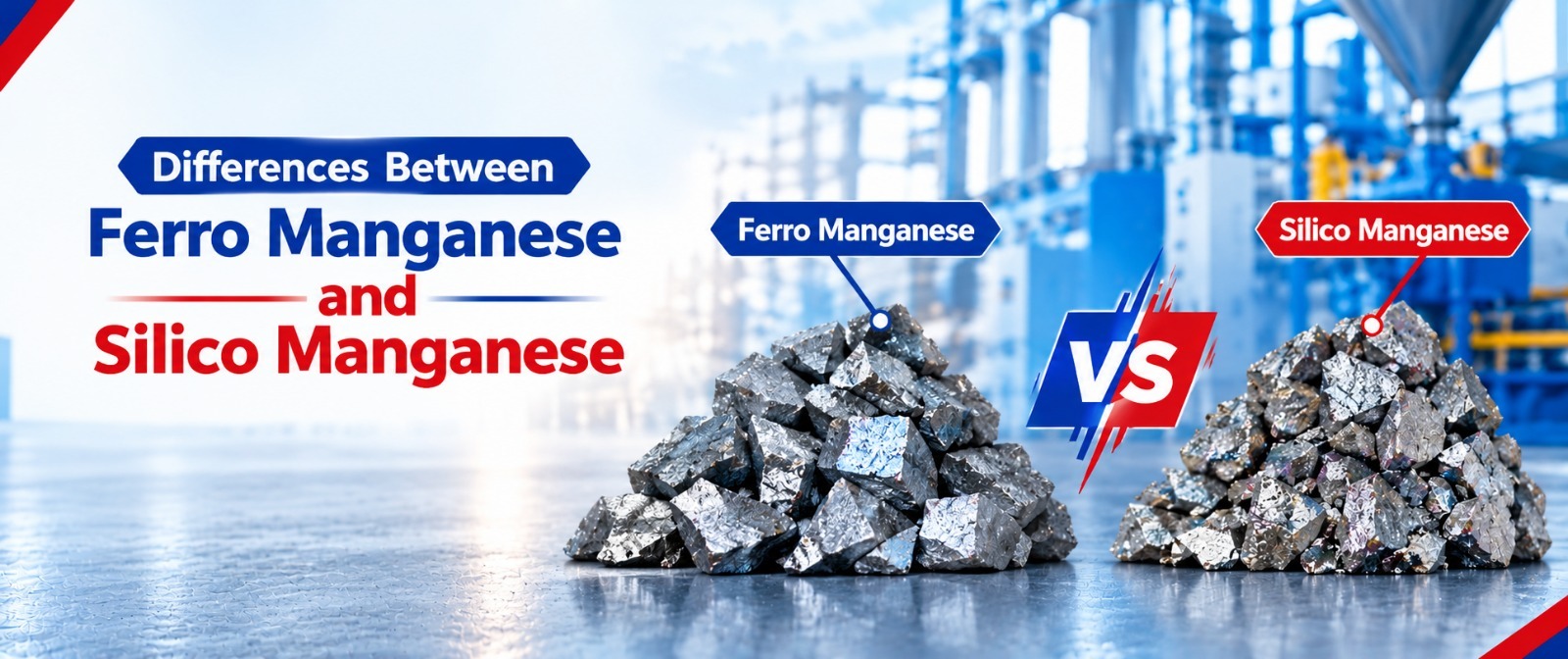
Ferroalloys are essential steelmaking inputs because they help steel producers adjust the chemistry of molten steel to meet the requirements of a particular grade. Ferro Manganese (FeMn) and Silico Manganese (SiMn) are both important manganese-bearing alloys, but they are not interchangeable in every application.
The key distinction is what each alloy contributes to the melt. Ferro Manganese is selected mainly to add manganese while controlling carbon and other residual elements. Silico Manganese supplies both manganese and a substantially higher proportion of silicon, making it useful when the steelmaker needs both elements and a deoxidising addition.
For steelmakers, foundries, and procurement teams, selection should be based on the target steel chemistry, the recovery of each element in the plant’s process, and the applicable product specification—not on manganese percentage or price alone. This guide explains the practical differences and relates them to BFCL’s manufacturing capabilities and published product range.
What Is Ferro Manganese?
Ferro Manganese is an iron-based ferroalloy in which manganese is the principal alloying element. In steelmaking, manganese contributes to strength and hardenability and helps address the harmful effects of sulphur by favouring the formation of manganese sulphide rather than iron sulphide. It can also contribute to deoxidation, although silicon is generally the stronger deoxidiser.
Ferro Manganese is produced in High Carbon, Medium Carbon and Low Carbon grades. The correct grade depends on how much manganese the steel requires and how much carbon can be introduced without exceeding the finished steel’s limit. Other elements—particularly phosphorus, silicon and sulphur—must also meet the steelmaker’s specification.
BFCL manufactures High Carbon Ferro Manganese through submerged electric arc furnaces and refined Medium and Low Carbon Ferro Manganese through its CLU converter route. BFCL offers High Carbon Ferro Manganese grades with 70–78% minimum manganese and Medium/Low Carbon grades spanning 73–85% manganese, depending on grade. Its Low Carbon range includes a maximum carbon specification of 0.10%.
What Is Silico Manganese?
Silico Manganese is an iron-based alloy that supplies manganese and silicon together. Manganese contributes to the required steel chemistry, while silicon is an effective deoxidiser: it reacts with dissolved oxygen and forms oxide products that are separated during steelmaking. The combined addition can be useful where the process requires both elements.
BFCL manufactures Silico Manganese using submerged electric arc furnaces. It offers SiMn (both HC and LC) with minimum manganese levels of 55%, 60% and 65%, paired with different minimum silicon levels and carbon, phosphorus and sulphur limits. These are distinct grade options, not one universal composition; buyers should select the specification that matches their steelmaking practice.
15 Key Differences Between Ferro Manganese and Silico Manganese
1. Main Chemical Composition
The primary difference is the balance of manganese, silicon and carbon in the two alloys.
Ferro Manganese is generally chosen as a concentrated source of manganese, with silicon normally restricted to a relatively low level. Silico Manganese is designed to supply meaningful quantities of both manganese and silicon. The total chemistry—including carbon, phosphorus and sulphur—matters because every addition can affect the final steel analysis.
In BFCL’s published High Carbon Ferro Manganese range, manganese is specified at 70–78% minimum and silicon at 1% maximum. BFCL’s Silico Manganese grades have different combinations of manganese and silicon—for example, specifications include 60% minimum Mn with 14% minimum Si, 65% minimum Mn with 16% minimum Si, and higher-silicon grades.
Its Low Carbon Silico Manganese specifications include manganese levels starting around 55%–60% and silicon levels ranging from approximately 27% to 31% depending on the grade.
2. Silicon Content
Silicon is usually a controlled, relatively low-level constituent in Ferro Manganese, whereas it is a major constituent of Silico Manganese.
3. Manganese Content
Both alloys provide manganese, but their manganese percentages and the amount of silicon delivered with that manganese differ.
BFCL offers 70–78% minimum manganese for High Carbon Ferro Manganese and 70–84% across its Medium and Low Carbon Ferro Manganese range. BFCL’s Silico Manganese range includes grades with 55%–60% for LC SiMn and 60% and 65% minimum manganese for HC SiMn.
4. Carbon Levels
Carbon is often a decisive selection factor, especially for low-carbon and special-grade steels.
Ferro Manganese is available in High, Medium and Low Carbon grades, allowing a steelmaker to add manganese while managing the carbon contribution. The relevant comparison is not simply the alloy’s carbon percentage: the addition rate, carbon recovery and other charge materials also influence the final steel carbon.
BFCL offers High Carbon Ferro Manganese specification lists carbon at up to 7% whereas its refined Medium and Low Carbon grades provide lower-carbon options, including specifications with maximum carbon of 1.5%, 1.0%, 0.5% and 0.1%, depending on grade. BFCL’s CLU converter is the route used to produce refined Medium and Low Carbon Ferro Manganese.
Silico Manganese also has grade-dependent carbon limits. BFCL’s published specifications include maximum carbon limits of 2.50%, 2.00%, 0.50%, 0.10% and 0.05% for different SiMn grades. These values are not interchangeable; the buyer should identify the required grade and verify all elements in the agreed specification.
5. Role in Steelmaking
Ferro Manganese is commonly selected when the main requirement is to raise or adjust manganese while controlling the introduction of silicon and carbon. Manganese contributes to strength and hardenability and helps control sulphur-related hot-shortness by favouring manganese sulphide formation. The precise effect depends on the steel grade and processing route.
Silico Manganese is selected when the steelmaker needs manganese and silicon together.
The practical question is therefore: which alloy delivers the required manganese and silicon, within the carbon and impurity limits, at the addition rate and recovery expected in the steel plant?
6. Deoxidation Function
Deoxidation removes dissolved oxygen from molten steel and helps control oxide inclusions. Both alloys can participate in deoxidation, but their contributions are not equal.
FeMn is most often valued as a manganese addition, with its deoxidising contribution considered as part of the overall steelmaking practice.
Silico Manganese contains substantially more silicon. Silicon reacts with dissolved oxygen to form silica-bearing oxide products.
7. Steel Grades and Applications
Ferro Manganese is used in a broad range of carbon and alloy steels. The selected carbon grade is especially important when the finished steel has a strict carbon limit.
BFCL’s Medium and Low Carbon Ferro Manganese as suitable for stainless and special-grade steel applications, including toolmaking, automobile spare parts and heavy-duty machinery parts.
Silico Manganese is widely used in steelmaking where a combined manganese and silicon addition is beneficial. Its suitability depends on whether the silicon addition fits the target steel chemistry and the plant’s deoxidation practice.
8. Manufacturing Process
The manufacturing route is important because it affects which grades can be produced and how the chemistry is controlled.
BFCL produces High Carbon Ferro Manganese and Silico Manganese in submerged electric arc furnaces. Its refined Medium and Low Carbon Ferro Manganese is produced through a separate refining route using a 12-tonne CLU converter supplied by UHT AB, Sweden. In this process, carbon is oxidised from the high-carbon liquid metal to achieve the required lower-carbon specification. Production route alone does not guarantee a result; the agreed grade specification and quality checks remain decisive.
9. Carbon Control Options
A key advantage of Ferro Manganese is the availability of multiple carbon grades. The choice enables the steelmaker to add manganese while limiting the carbon introduced by the alloy.
High Carbon Ferro Manganese may be suitable where the target steel chemistry can accommodate its carbon contribution and where its other chemistry limits are met.
Where carbon must be controlled more tightly, Medium or Low Carbon Ferro Manganese may be the better option. The selection should be based on the full charge calculation, not carbon percentage alone. This is where BFCL’s CLU converter capability comes into play.
10. Effect on Final Steel Properties
Manganese can increase strength and hardenability and plays an important role in sulphur control. Silicon is used primarily as a deoxidiser in many steelmaking practices and can also influence strength and other properties when retained in the finished steel.
Because SiMn adds both manganese and silicon, its effect on final chemistry differs from an FeMn addition. The alloy choice influences how much of each element enters the melt and how much is retained after refining.
The final result depends on the steel grade, starting chemistry, addition quantity, recovery rates, oxygen level, slag conditions and process sequence. Alloy selection should therefore be based on the steel plant’s target analysis and operating data.
11. Typical Product Grades
Ferro Manganese is commonly grouped into High Carbon, Medium Carbon and Low Carbon grades, with specific chemistry limits within each group. Silico Manganese is also offered in multiple grades, distinguished by manganese, silicon, carbon and impurity specifications. Grade names alone are not enough: the purchase specification should state the required minimums and maximums for each relevant element.
12. Importance of Silicon in the Selection
Silicon can be the deciding factor between the two alloys. If the steel requires manganese but has little room for additional silicon, a suitable Ferro Manganese grade may be preferred. If the process requires both manganese and silicon, SiMn may provide a practical combined addition. The steelmaker should calculate the expected contribution of each element and confirm that all limits will be met.
13. Quality Control Requirements
Chemical consistency matters because variation in manganese, silicon, carbon, phosphorus or sulphur can affect steel chemistry, alloy consumption and process control. Buyers should agree on a grade-specific specification, review the certificate of analysis (CoA), and confirm sampling, testing and acceptance requirements before shipment. BFCL’s has its own laboratory capability including LECO carbon analysis and XRF testing. The applicable test method and acceptance limits should be agreed for the product and order.
14. How should steelmakers choose?
There is no universally superior alloy. Start with the target steel analysis and calculate the required manganese and silicon additions. Then assess carbon and impurity limits, expected recovery, addition point, process sequence, particle size and handling requirements. Finally, compare the cost of meeting the chemistry—not merely the price per tonne—including the amount required and the contribution of each element. The best choice is the grade that reliably meets the plant’s technical and production needs.
15. Supply, Handling and Procurement Considerations
The technical specification is only one part of a successful purchase. Buyers should also confirm the required size range, fines tolerance, packing method, inspection and sampling arrangements, moisture or contamination controls where relevant, loading plan, shipping documents and delivery window. These requirements should be agreed before production or dispatch so that the delivered material is suitable for the customer’s charging system and receiving facilities.
Ferro Manganese vs Silico Manganese: Quick Comparison
| Parameter | Ferro Manganese | Silico Manganese |
|---|---|---|
| Main elements | Primarily manganese and iron; silicon and other elements controlled by grade | Manganese, silicon and iron; carbon and impurities controlled by grade |
| Main purpose | Mainly manganese addition | Combined manganese and silicon addition; commonly used for silicon-based deoxidation |
| BFCL Offers | High Carbon: 70–78% minimum; Medium/Low Carbon range: 70–84% depending on grade | Grades include Mn 55%–60% (LC) and 60%–65% (HC) Mn; check selected grade |
| Silicon | Generally low; BFCL High Carbon FeMn lists 1% maximum | A major constituent; BFCL specifications include different minimum Si levels by grade |
| Carbon grades | High, Medium and Low Carbon options; BFCL offers grades down to 0.10% maximum C | Grade-dependent; BFCL specifications include maximum C limits of 2.50%, 2.00%, 0.50%, 0.10% and 0.05% |
| Deoxidation contribution | Can contribute; manganese is generally a weaker deoxidiser than silicon | Silicon provides a stronger deoxidising contribution, alongside manganese |
| Typical application | Steel grades requiring manganese with specified carbon and silicon limits | Steelmaking where both Mn and Si additions are required |
| BFCL production route | High Carbon: submerged electric arc furnace; Medium/Low Carbon: CLU converter refining route | Submerged electric arc furnace |
| Grade selection | Based on Mn requirement, carbon limit, silicon and impurity limits | Based on combined Mn and Si requirements, carbon and impurity limits |
| Key advantage | Multiple carbon grades allow manganese addition with controlled carbon input | Supplies manganese and silicon together in one alloy addition |
Why Supplier Capability Matters
Selecting a ferroalloy supplier involves more than comparing the quoted price per tonne. Buyers should consider the supplier’s grade range, process capability, chemical testing, consistency, order planning, packing options and ability to meet the agreed shipment schedule. BFCL, established in 1971, manufactures Ferro Manganese and Silico Manganese alongside Sponge Iron. Its high-carbon ferroalloy operations use submerged electric arc furnaces, while refined Medium and Low Carbon Ferro Manganese is produced through its CLU converter route.
BFCL exports to more than 25 countries and annual ferroalloy production of approximately 100,000 MT, including approximately 60,000 MT of refined Ferro Manganese through the CLU route. Its published quality information refers to laboratory facilities including LECO carbon analysis and XRF. For export buyers, a clear specification, agreed inspection and documentation requirements, suitable packing, and realistic shipment planning are all important parts of dependable supply.
Final Thoughts
Ferro Manganese and Silico Manganese both supply manganese, but they differ in silicon content, carbon options and their role in the steelmaking process. Ferro Manganese is generally selected to adjust manganese with controlled silicon; Silico Manganese provides manganese and silicon together and can support silicon-based deoxidation.
The correct selection depends on the target steel chemistry, carbon and impurity limits, expected element recovery and plant practice. Steelmakers should evaluate the total chemistry contribution and process outcome rather than choosing solely by alloy price or manganese percentage.
With more than five decades of experience, a broad Ferro Manganese and Silico Manganese portfolio, established manufacturing routes and laboratory capability, BFCL supplies ferroalloys to customers in India and international markets.
Share:


